

Picture this: you’re sitting at your kitchen table, laptop open to a sleek online lender portal promising “approval in minutes,” and your phone is right there with the local bank’s number already pulled up. You’ve done enough research to know you want an FHA loan. What you don’t know is which path actually gets you to the closing table with the best terms — or whether one of these channels might quietly reject you despite FHA guidelines saying you qualify.
This is not a generic mortgage debate. The choice between online mortgage lenders vs traditional banks carries real, dollar-denominated consequences for FHA borrowers specifically. And the answer isn’t as simple as “online is faster” or “banks are safer.” The more important variables are FHA expertise, overlay policies, and whether your lender is a direct retail channel or an independent broker with access to multiple wholesale investors simultaneously.
Here’s the thing that most comparison articles miss: the lender type you choose can mean the difference between a 580-score approval and a rejection — even when FHA guidelines say you qualify. HUD sets the floor. Your lender sets the ceiling on how much they’ll actually work within those guidelines. That gap is where borrowers get lost.
This article walks through that gap in detail, using the broker lens of Duane Buziak at Coast2Coast Mortgage LLC (NMLS #1110647, Co. NMLS #376205) — a mortgage broker, not a lender or banker — with access to hundreds of wholesale lenders and a Dare to Compare pricing challenge that puts that access to work for FHA borrowers in Virginia, Florida, Tennessee, Georgia, and DC.
Three Channels, Three Very Different FHA Experiences
Before comparing costs and timelines, it helps to understand that “online lender” and “traditional bank” don’t exhaust your options. There are three distinct channels relevant to FHA borrowers, and they function differently in ways that matter.
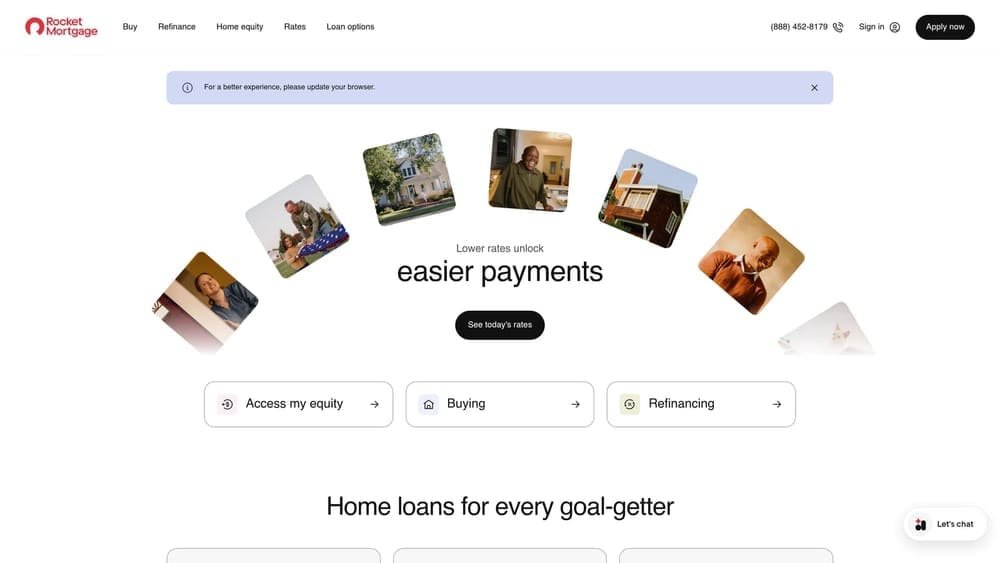
Large Online Retail Lenders: Companies like Rocket Mortgage and Movement Mortgage originate loans directly. They fund from their own balance sheet or sell immediately to the secondary market. They set their own overlay policies, and their loan officers work within a single product shelf — whatever that institution offers.
Traditional Banks and Credit Unions: Local and regional banks originate FHA loans too, but FHA volume at a typical bank branch is often lower than at a dedicated FHA broker shop. That matters because FHA-specific expertise — navigating gift funds, non-occupant co-borrowers, disputed accounts — is built through repetition. A loan officer who handles a handful of FHA files per year is working from a different knowledge base than one who does dozens per month.
Independent Mortgage Brokers: This is the structural distinction most borrowers miss. A broker like Coast2Coast is not a lender or banker. The broker submits your FHA file to multiple wholesale lenders simultaneously, creating competitive pressure on rate and fees that no single-channel institution can replicate. You get multiple investor bids on one application.
Now, the overlay issue. HUD sets the FHA floor: 580 FICO with 3.5% down, or 500–579 FICO with 10% down (HUD Handbook 4000.1). But every lender, bank, and wholesale investor can layer stricter internal requirements on top. A traditional bank might require 620 FICO even though FHA allows 580. An online retail lender might cap DTI at 45% even though FHA allows up to 57% with compensating factors (HUD Handbook 4000.1, Section II.A.4.d). These overlays are internal policies — they’re not published on a rate sheet, and they vary widely.
A broker shopping multiple wholesale investors can match a borrower’s profile to the investor with the thinnest overlay. That’s not a marketing claim — it’s a structural feature of the broker model.
One more meaningful distinction: the NoTouch Credit Pull. First Heritage Mortgage (Michael Cao, NMLS #323021, 4551 Cox Road Suite 305, Glen Allen VA 23060, 804-292-2100), First Home Mortgage (Courtney Ficken, NMLS #1172565, 6802 Paragon Place, Richmond VA), ALCOVA Mortgage (NMLS #40508, 855-462-5268), and Rocket Mortgage cannot pre-qualify FHA borrowers without a hard pull on the same terms. Coast2Coast’s NoTouch Credit Pull allows soft-pull pre-qualification — no hard inquiry, no credit score impact — which matters significantly when you’re comparison shopping or credit-sensitive.
Breaking Down the Real Costs: Rates, Fees, and MIP
Here’s one thing the online vs. traditional bank debate cannot change: FHA mortgage insurance premiums. MIP is federally standardized. It does not vary by lender channel, loan officer expertise, or how slick the portal looks.
The upfront MIP (UFMIP) is 1.75% of the base loan amount, flat, for all FHA loans (Source: HUD Mortgagee Letter 2015-01). The annual MIP for the most common tier — 30-year term, LTV greater than 95%, loan amount at or below $726,200 — is 0.55% of the outstanding loan balance (Source: HUD Mortgagee Letter 2023-05, effective March 20, 2023). Whether you close through Rocket, a community bank, or Coast2Coast, those numbers don’t move.
To make this concrete, here’s a worked total cost of ownership example for a Henrico County, Virginia FHA purchase (property tax rate: $0.85 per $100 of assessed value, Source: henrico.us/services/real-estate-assessments/, verified August 2026).
Purchase Price: $300,000
Down Payment (3.5%): $10,500
Base Loan Amount: $289,500
UFMIP (1.75%): $289,500 × 1.75% = $5,066.25 (typically financed into the loan)
Financed Loan Amount: $294,566.25
Annual MIP (0.55%): $289,500 × 0.55% = $1,592.25 per year / $132.69 per month
Annual Property Tax (Henrico, $0.85/$100): $300,000 × 0.0085 = $2,550 per year / $212.50 per month
Principal and interest will vary based on the interest rate you lock — current FHA rates are available through Coast2Coast’s rate comparison tool. The point is that your MIP and property tax lines are fixed inputs. The variable that differs between an online lender, a bank, and a broker is the interest rate and origination fees.
Origination fee differences of even 0.5% on a $294,566 loan represent nearly $1,500 at closing. Broker access to hundreds of wholesale lenders creates genuine competitive pressure on that line item in a way that a single retail channel cannot. That’s where the Dare to Compare challenge lives: bring a competing offer and see whether Coast2Coast’s wholesale pricing beats it.
For context on loan limits: the 2026 FHA loan limit for a single-unit property in Henrico County (a standard-cost area) is $541,287, effective for case numbers assigned on or after January 1, 2026 (Source: HUD Mortgagee Letter 2025-23, hud.gov/program_offices/housing/sfh/lender/origination/limits). This ceiling applies equally to online lenders, banks, and brokers — it’s geography-driven, not channel-driven.
Speed Claims vs. FHA Underwriting Reality
Online lenders market speed aggressively. “Get approved in minutes” is a common headline. Here’s what that actually means in an FHA context — and where the claim starts to blur.
Automated underwriting through Fannie Mae’s Desktop Underwriter (DU) or Freddie Mac’s Loan Prospector (LP) can issue an Approve/Eligible finding quickly. That’s real. But an FHA loan still requires case number assignment through HUD’s system, an FHA appraisal (which must be ordered through an FHA-approved appraiser and cannot be waived), and HUD compliance documentation that no technology platform eliminates. The “minutes to approval” is a pre-approval timeline. The clear-to-close timeline — the one that actually matters — is a different number.
Traditional banks often have in-house underwriters, which can streamline communication. But if the loan officer handling your FHA file sees relatively few FHA transactions per month, FHA-specific nuances can slow things down or generate unnecessary conditions. Issues like gift fund documentation, non-occupant co-borrower structuring, and FHA-specific appraisal repair requirements require familiarity that comes from volume. A bank branch that primarily handles conventional loans may not have that depth readily available.
The sharpest difference in processing speed and accuracy shows up for self-employed borrowers and those with non-traditional income. Banks tend to apply stricter income documentation overlays — two years of tax returns, no exceptions, even when HUD guidelines allow more flexibility. An experienced FHA broker can route a self-employed borrower’s file to a wholesale investor with more accommodating income interpretation within HUD’s published guidelines. That’s not bending the rules; it’s knowing which investor’s overlay policies align with which borrower profile.
Regardless of which channel you use, the mortgage application checklist and self-employed income verification prep are critical steps. Arriving at pre-approval with complete documentation — two years of W-2s or tax returns, 60 days of bank statements, current pay stubs, and identification — compresses timelines for any lender type. The channel doesn’t change what HUD requires. It changes how efficiently and accurately those requirements are navigated.
What the Credit Score Tables Don’t Show: FHA Overlay Policies in Practice
Most comparison articles show a simple table: FHA allows 580 FICO with 3.5% down. What they don’t show is the overlay layer that sits between HUD’s published minimums and what any given lender will actually approve.
HUD’s published minimums (HUD Handbook 4000.1) are clear: 580 or above qualifies for 3.5% down; 500 to 579 qualifies with 10% down. Below 500, FHA financing is not available. These are the floors. Every lender, bank, and wholesale investor can set higher internal minimums.
A typical traditional bank may require 620 FICO for FHA as an internal policy, even though HUD allows 580. Some large online retail lenders have similar overlays. Rocket Mortgage, Movement Mortgage, NFM Lending, Sparrow Home Loans, and CFMortgage Corp each maintain their own overlay policies — the specific FICO floors should be verified directly with each lender before any application, as these policies change. The point is not to characterize any one lender’s policy as a permanent fact; it’s to establish that the gap between HUD’s floor and any lender’s actual minimum is real and variable.
A broker with access to multiple wholesale investors can match a borrower’s FICO score to the investor whose overlay is thinnest for that profile. A 595-score borrower who gets declined at a bank or by an online retail lender with a 620 overlay may have a compliant approval path through a wholesale investor that works at 580. Same borrower, same FHA guidelines, different outcome based on channel.
The DTI overlay story is similar. FHA allows back-end DTI up to 57% with compensating factors (HUD Handbook 4000.1, Section II.A.4.d). Many banks cap internally at 45% to 50%. Online retail lenders vary. Broker access means the DTI ceiling can be optimized per borrower rather than accepting a single institution’s internal limit as final.
Collections, disputed accounts, and non-traditional credit are another area where channel expertise diverges sharply. HUD Handbook 4000.1 has specific guidance on how these situations should be handled — guidance that an experienced FHA broker applies regularly. A bank loan officer with limited FHA volume may default to denial on a file with disputed collections, not because FHA requires it, but because the internal training didn’t cover the compliant path forward. Knowing the difference between HUD’s actual requirement and an institution’s internal conservatism is one of the clearest advantages of working with a dedicated FHA broker.
The Broker Structural Advantage for FHA Borrowers in Virginia
The structural distinction is worth restating plainly: Coast2Coast Mortgage LLC (NMLS #376205) is a mortgage broker, not a lender or banker. When you submit an FHA application through Coast2Coast, that file goes to multiple wholesale lenders simultaneously. Each investor competes for your loan. The pricing pressure that creates — on rate, on origination fees, on lender credits — is not available when you apply through a single-channel institution, regardless of how large or technologically sophisticated that institution is.
For Virginia borrowers specifically, local property tax context matters more than most out-of-state online lenders will flag proactively. Property taxes feed directly into your monthly PITI payment and therefore your debt-to-income ratio. Here are the verified county rates as of August 2026:
Henrico County: $0.85 per $100 of assessed value (Source: henrico.us/services/real-estate-assessments/)
Chesterfield County: $0.89 per $100 of assessed value (Source: chesterfield.gov/823/Real-Estate-Assessments)
Hanover County: $0.81 per $100 of assessed value (Source: hanovercounty.gov/386/Tax-Rates)
Stafford County: Rate was mid-change at time of publication — verify current rate at staffordcountyva.gov before use in any DTI calculation.
An out-of-state online lender’s algorithm may use a generic regional estimate for property taxes in its pre-approval calculation. That estimate can be off enough to affect DTI at the underwriting stage — a surprise that a local broker familiar with Virginia county assessor data avoids from the first conversation.
On the pre-approval process itself: the NoTouch Credit Pull that Coast2Coast offers means soft-pull pre-qualification with no hard inquiry and no credit score impact. This is a meaningful differentiator when you’re comparison shopping across lenders or when your score is in a range where protecting every point matters. First Heritage Mortgage, First Home Mortgage, ALCOVA Mortgage, and Rocket Mortgage require a hard pull to provide comparable pre-qualification terms — a fact worth knowing before you start collecting quotes.
Coast2Coast is licensed in Florida, Georgia, Kentucky, Maryland, North Carolina, South Carolina, Tennessee, Texas, Virginia, West Virginia, and DC. FHA loan limits vary by county within each of those states, and the broker’s familiarity with local market conditions — appraisal norms, seller concession practices, county-specific documentation requirements — adds practical value that a national online platform’s standardized process may not replicate.
Choosing the Right FHA Lender Channel for Your Specific Situation
The honest answer is that the right channel depends on your borrower profile. Here’s a practical decision framework.
Strong Credit (680+), W-2 Income, Standard Purchase: Any channel can likely execute this loan. The competitive variable is rate and origination fees. In this scenario, the Dare to Compare approach — getting a broker quote alongside retail quotes — is still worth doing, because wholesale pricing often wins even on straightforward files. But the risk of overlay-related denial is low regardless of channel.
Credit Score 580–619, Complex Income, or Recent Credit Events: This is where broker access to thin-overlay wholesale investors is materially advantageous. A bank or online retail lender with a 620 overlay is a dead end for a 595-score borrower. A broker who can route to a 580-overlay investor is not. The difference isn’t negotiating skill — it’s structural access.
First-Time Buyer Needing Down Payment Support: A broker can layer state and local down payment assistance programs alongside FHA financing in ways that a single-channel lender may not be set up to accommodate. Virginia has several programs worth exploring — a broker familiar with the state’s assistance landscape can assess eligibility alongside the FHA pre-qualification.
Before applying anywhere, ask every lender — online, bank, or broker — these specific questions:
1. What is your minimum FICO score for FHA approval?
2. What is your maximum back-end DTI with compensating factors?
3. Do you require a hard credit pull for pre-qualification?
4. What are your origination fees and discount points on a loan of my size?
5. What is your average FHA clear-to-close timeline from application to funding?
These questions apply equally to Rocket Mortgage, Movement Mortgage, your local bank branch, and any broker. The answers reveal overlay policy, fee structure, and processing depth in a way that a rate quote alone does not.
One compliance note that applies universally: verify any lender’s NMLS license for your state before proceeding. Coast2Coast Mortgage LLC (NMLS #376205) is licensed in FL, GA, KY, MD, NC, SC, TN, TX, VA, WV, and DC. Not all online lenders are licensed in all states, and FHA loan limits vary by county within each state — the 2026 limit for a standard-cost area is $541,287 for a single-unit property, but high-cost areas can reach $1,249,125 (Source: HUD Mortgagee Letter 2025-23, effective for case numbers assigned on or after January 1, 2026).
The Right Question for FHA Borrowers
The online lender vs. traditional bank debate is largely the wrong frame for FHA borrowers. The right question is whether your lender — regardless of channel — has genuine FHA depth, access to investors with thin overlays, and the ability to deliver competitive wholesale pricing on your specific loan profile.
MIP is standardized. Loan limits are geography-driven. What varies is the rate you lock, the fees you pay, the overlay policy that determines whether you’re approved at all, and the expertise of the person guiding your file through HUD’s compliance requirements. On all four of those variables, broker access to multiple wholesale investors creates structural advantages that a single-channel retail lender, online or traditional, cannot replicate by design.
That said, no channel is universally superior for every borrower. A straightforward W-2 borrower with strong credit can find competitive terms through multiple channels. The broker advantage sharpens as the borrower profile becomes more complex — lower scores, non-traditional income, recent credit events, or DTI near FHA’s upper limits.
If you’re ready to find out exactly where you stand, schedule your free consultation today with Duane Buziak at Coast2Coast Mortgage LLC. Soft-pull pre-qualification is available through the NoTouch Credit Pull — no hard inquiry, no credit score impact. No-out-of-pocket closing options may be available depending on your loan structure. Coast2Coast is licensed in FL, GA, KY, MD, NC, SC, TN, TX, VA, WV, and DC, with access to hundreds of wholesale lenders and a Dare to Compare pricing challenge. Reach Duane directly at 804-212-8663 or duane@coast2coastml.com. Office: 4860 Cox Rd, Glen Allen, VA 23060.