
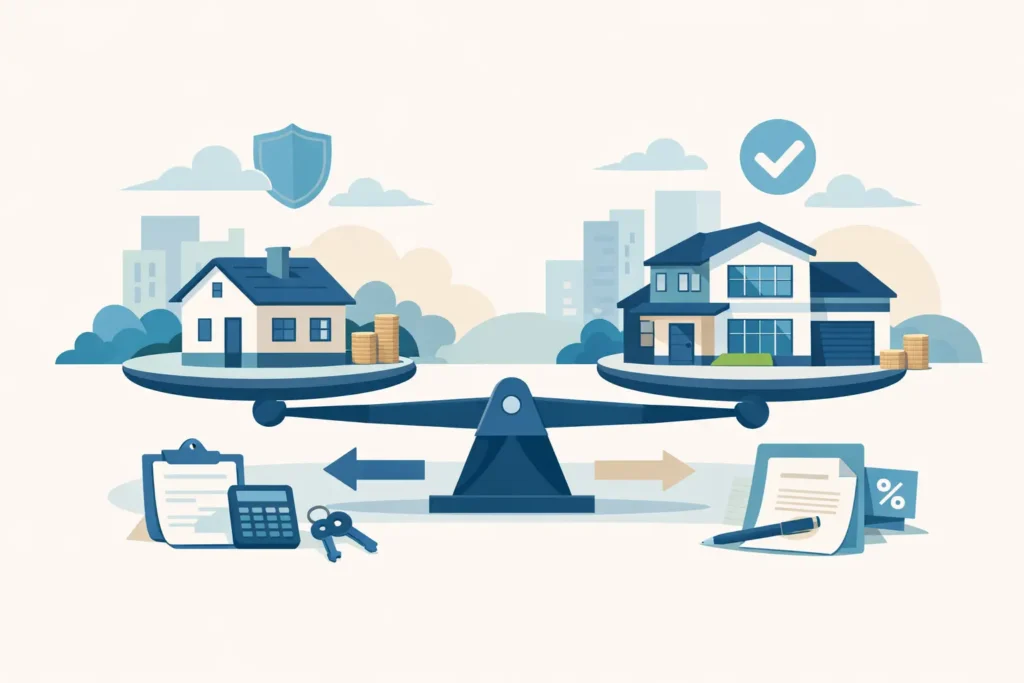

If you’re asking, Is FHA better than a conventional loan?, the honest answer is no – not across the board. FHA is often better for buyers with lower credit scores, smaller down payments, or more underwriting hurdles. Conventional is often better for buyers with stronger credit and enough cash to avoid long-term mortgage insurance.
Duane Buziak, NMLS #1110647
Table of Contents
- FHA vs. conventional in plain English
- When FHA is usually the better option
- When conventional usually wins
- A real payment example with math
- Side-by-side comparison table
- What first-time buyers get wrong most often
- FAQs
- Legal disclaimer
FHA vs. conventional in plain English
FHA and conventional loans solve different problems. FHA is built to help buyers qualify with more flexible credit standards and just 3.5% down in many cases. Conventional loans can go as low as 3% down for qualified buyers, but approval usually gets tougher as credit scores drop and debt ratios rise.
That means FHA tends to work better when your file needs flexibility. Conventional tends to work better when your credit profile is strong enough to earn better pricing and cheaper monthly mortgage insurance.
The mistake buyers make is focusing only on the down payment. The smarter move is to compare the full monthly payment, the upfront cash needed, and how long mortgage insurance will stay on the loan.
When FHA is usually the better option
FHA often makes more sense if your credit score is in the high-500s to low-600s, if you had past credit events, or if your debt-to-income ratio is pushing the limit. FHA underwriting is generally more forgiving than conventional. That is the reason so many first-time buyers and credit-challenged borrowers start there.
It can also be the better fit if you need down payment assistance paired with the loan, or if you’re buying a home that needs repairs and may fit an FHA 203(k) renovation strategy. For borrowers who are nervous about getting pre-approved, a soft pull mortgage pre approval can reduce friction early in the process.
At the broker level, I also see FHA win when a buyer has been told no by a retail bank with one narrow credit box. A broker can shop the file across a broad wholesale network and look for a cleaner approval path. That matters more than most buyers realize.
When conventional usually wins
Conventional usually wins when your credit is solid, often 680 and above, and especially when you’re over 700. Better credit can mean lower rates, cheaper private mortgage insurance, and more flexibility long term.
The biggest advantage is mortgage insurance. FHA charges both upfront mortgage insurance premium and annual MIP. In many FHA loans, that monthly MIP stays for the life of the loan unless you refinance or put enough down up front. Conventional PMI, by contrast, can eventually cancel once you reach the required equity position.
So if you have strong credit and plan to stay in the home for years, conventional can be less expensive over time even if FHA looks easier at first glance.
A real payment example with math
Let’s use a realistic purchase example.
Home price: $300,000
FHA at 3.5% down means a down payment of $10,500. Base loan amount is $289,500. FHA also charges an upfront mortgage insurance premium of 1.75%. That adds $5,066.25, creating a total loan amount of $294,566.25 if financed.
Now use a sample 30-year fixed rate of 6.50%. Principal and interest on $294,566.25 is about $1,861 per month. Annual FHA MIP on a typical high-LTV 30-year loan is 0.55% of the base loan amount. That equals $1,592.25 per year, or about $132.69 per month.
Estimated monthly before taxes and homeowners insurance: about $1,993.69.
Now compare a conventional loan at 3% down on the same $300,000 home. Down payment is $9,000, so the loan amount is $291,000. At the same sample 6.50% rate, principal and interest is about $1,839 per month. PMI varies by credit score, loan-to-value, and other factors, but a borrower with decent credit might pay around $120 per month.
Estimated monthly before taxes and homeowners insurance: about $1,959.
In this example, conventional is slightly cheaper monthly and needs $1,500 less down. But that does not mean the buyer qualifies for it. If the conventional approval falls apart because of credit score, automated underwriting, or reserve issues, FHA becomes the better loan because it actually closes.
Side-by-side comparison table
| Feature | FHA | Conventional | What it means for buyers |
|---|---|---|---|
| Minimum down payment | 3.5% with qualifying credit | As low as 3% for qualifying programs | Both can be low-down-payment, but conventional approval is usually less forgiving. |
| Credit flexibility | Stronger option for bruised credit | Usually better for stronger credit profiles | FHA often helps buyers in the 580-619 range more than conventional. |
| Mortgage insurance | Upfront MIP plus monthly MIP | Monthly PMI, often cancelable later | Conventional can cost less over time if your credit is good. |
| Debt-to-income tolerance | Often more flexible | Can be tighter depending on the file | FHA may approve buyers conventional systems decline. |
| Property condition | Stricter appraisal and safety standards | Can be easier on some properties | Homes needing repairs may face more friction with FHA unless using 203(k). |
What first-time buyers get wrong most often
The biggest misunderstanding is thinking FHA is the first-time buyer loan and conventional is the move-up buyer loan. That’s too simplistic. FHA is available to repeat buyers too, and conventional is not automatically better just because someone says your credit score is decent.
Another mistake is shopping only by rate quote. A lower rate does not always mean a lower payment once MIP or PMI is added. Buyers also underestimate the approval side. The loan that looks best online is worthless if the file cannot get through underwriting.
That is why many buyers start with a no hard credit check mortgage pre approval or a soft pull home loan pre approval. A NoTouch Credit Pull gives you an early read without adding anxiety around a hard inquiry. If you’re still comparing options, a mortgage pre approval without hard inquiry or a soft credit pull mortgage application can help frame the decision before you commit.
NoTouch Credit Pull is especially useful for buyers who are close on score, worried about debt ratios, or simply not ready for a full hard-pull pre-approval. NoTouch Credit Pull does not replace full underwriting, but it helps you understand whether FHA or conventional is the smarter lane.
Is FHA better than a conventional loan for most buyers?
For most buyers, the better loan is the one that balances approval odds, cash to close, and long-term cost. If your credit is average or below average, FHA often gives you the cleaner path. If your credit is strong and you can qualify comfortably, conventional often gives you better long-term economics.
So the right question is not which loan is better in general. It is which loan is better for your exact credit, income, down payment, and property.
FAQs
Is FHA better than a conventional loan for bad credit?
FHA is often better for buyers with lower credit scores because underwriting is typically more flexible. If your score is borderline or you have prior credit issues, FHA may approve you where conventional does not. Better approval odds can matter more than a slightly lower payment.
Is FHA cheaper monthly than conventional?
Sometimes, but not always. FHA includes upfront and monthly mortgage insurance, while conventional PMI depends heavily on credit and down payment. Buyers with stronger credit often see conventional come in cheaper over time, even if FHA is easier to qualify for.
Which loan is easier to qualify for?
In most cases, FHA is easier to qualify for. It tends to allow more flexibility on credit history, debt ratios, and past financial setbacks. Conventional can be excellent, but the file usually needs to be cleaner to get approved on favorable terms.
Do first-time buyers have to use FHA?
No. First-time buyers can use either FHA or conventional. FHA is common because of flexible guidelines, but conventional may be the better fit if your credit is strong and you want mortgage insurance that can eventually fall off.
Is mortgage insurance worse on FHA?
For many borrowers, yes. FHA has both upfront MIP and monthly MIP, and that monthly charge may stay much longer than conventional PMI. Conventional usually becomes more attractive when credit scores are higher and long-term savings matter.
Can I buy with less money down using conventional?
Yes, sometimes. Certain conventional programs allow as little as 3% down, compared with FHA’s 3.5% minimum for many borrowers. But lower down payment does not help if the credit profile is not strong enough to qualify.
Should I compare both before getting pre-approved?
Absolutely. A side-by-side review is the best way to see which loan truly fits. Many buyers assume FHA is their only option or that conventional is automatically better. The numbers often tell a different story once payment and approval strength are both considered.
What is the best first step if I’m unsure?
Start with a soft-pull review of your credit and scenario. That lets you compare FHA and conventional without jumping straight into a hard inquiry. It is a practical way to lower stress and get real answers before making an offer.
Legal disclaimer
This article is for general educational purposes only and is not a commitment to lend. Rates, mortgage insurance, approval standards, and loan eligibility change based on market conditions, credit profile, occupancy, and property details. All loan scenarios must be reviewed by a licensed mortgage professional.
Duane Buziak, Mortgage Maestro | Coast2Coast Mortgage LLC | NMLS #1110647 | (804) 212-8663 | duane@coast2coastml.com | 4860 Cox Rd, Glen Allen VA 23060 | Licensed: VA, FL, TN, GA, DC | VA Broker of the Year 2024-2025 | Scotsman Guide Top Originator 2025 & 2026 | UWM PRO ELITE 2025 | Top 1% Nationwide | 1,400+ five-star reviews.