
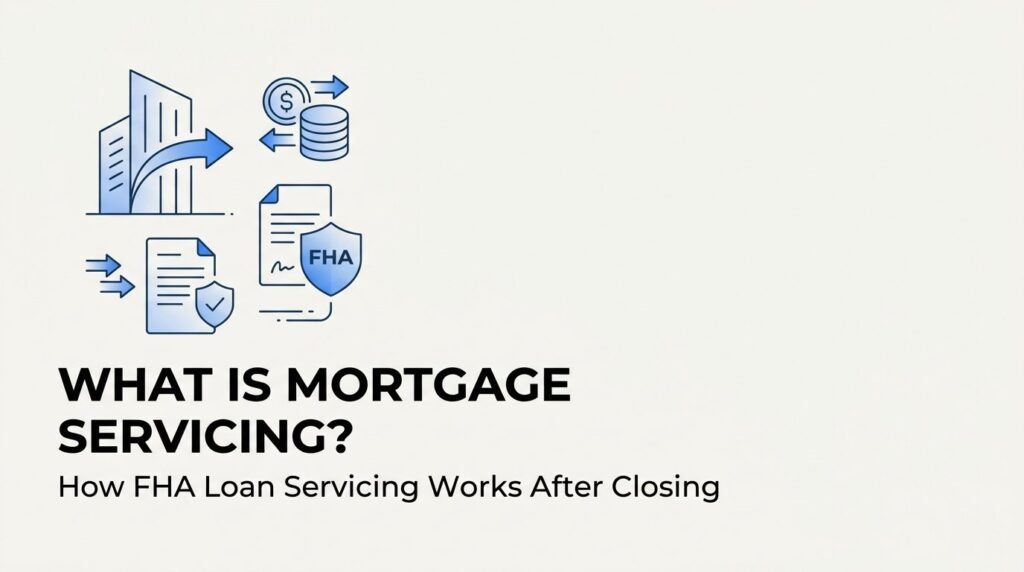

Mortgage servicing is the day-to-day administration of your loan after closing: collecting your payment, running your escrow account, and handling problems when they come up. On an FHA loan, the servicer also collects your annual mortgage insurance premium (MIP) and passes it along as required. The company you pay each month is often not the company that arranged your loan, and that is normal. Duane Buziak explains the system below, including who does what, where each dollar of your payment goes, and what protections you have if something goes wrong.
Quick answer: A mortgage servicer is the company that bills you, collects your monthly payment, manages your escrow account for taxes and insurance, and handles late payments and hardship requests. Servicing can be sold or transferred without changing your interest rate, term, or balance. Federal rules require advance notice of a transfer and give you a 60-day grace period for misdirected payments.
What a Mortgage Servicer Does After Closing
The servicer is the company you deal with for the life of the loan. It sends monthly statements, collects your payment, and splits that payment among principal, interest, and escrow. It tracks your balance, issues year-end tax statements, answers questions about your account, and decides how to respond when you fall behind.
Four roles get blurred together, and they are often held by different companies:
- Originator: the company that took your application and arranged the loan at the start.
- Owner of the note (the investor): whoever holds the right to be repaid. Many FHA loans are pooled into securities after closing.
- Servicer: the company that administers the loan day to day. It may or may not own the note.
- Insurer: for an FHA loan, HUD’s Federal Housing Administration insures the lender against loss if you default. HUD does not service your loan.
FHA servicing carries a few extra duties. The servicer collects your annual MIP as part of your monthly payment and remits it to HUD. It also reports your loan’s status to the FHA-insured loan record, which is how HUD tracks payments, defaults, and claims. If you ever need a hardship workout, the servicer must follow HUD’s loss mitigation rules rather than inventing its own.
Duane Buziak is a mortgage broker, which means his role comes at the front of the process: comparing wholesale options, helping you apply, and guiding you to closing. The servicing relationship usually begins with a different company once the loan funds. That handoff is routine, and your closing paperwork discloses whether the servicing may be transferred.
Where Your Monthly FHA Payment Actually Goes
An FHA payment is more than principal and interest. Most borrowers pay five components, and the servicer divides them for you.
Take an illustration. Suppose you buy a $300,000 home in Henrico County, Virginia, with 3.5% down. Your base loan is $289,500. The upfront mortgage insurance premium (UFMIP) is 1.75% of the base loan, or $5,066.25, which is typically financed, bringing the total loan to $294,566. (UFMIP of 1.75% is set in HUD Mortgagee Letter 2015-01.) At an assumed 6.5% rate on a 30-year term, principal and interest come to roughly $1,862 per month. The rate is a placeholder for the example, not a quote.
Annual MIP for a 30-year loan with less than 5% down and a base amount at or under $726,200 is 0.55%, per HUD Mortgagee Letter 2023-05. Confirm the current tier against HUD Handbook 4000.1 at hud.gov before relying on it. On $289,500, that is about $1,592 per year, or roughly $133 per month. Henrico’s real estate tax rate is $0.85 per $100 of assessed value, which on $300,000 is $2,550 per year, about $213 per month. Verify the current rate at henrico.us/services/real-estate-assessments/. Homeowners insurance varies widely; assume $1,500 per year, or $125 per month, for this example.
The sum is approximately $2,333 per month. Here is who receives each piece:
- Principal: reduces your balance; stays with the note holder.
- Interest: the cost of borrowing; goes to the note holder, less the servicer’s fee.
- Annual MIP (about $133): remitted to HUD to fund the FHA insurance program.
- Property tax (about $213): held in escrow, paid to the county when due.
- Homeowners insurance (about $125): held in escrow, paid to your insurer when due.
The escrow account is the servicer’s holding account. Each month it collects one-twelfth of your estimated annual tax and insurance bills, then pays them directly on the due dates. You never write those checks yourself, and a missed tax bill becomes the servicer’s problem to prevent, though ultimately it is your obligation to fund.
MIP structure at a glance
UFMIP is 1.75% of the base loan amount. Annual MIP depends on loan term, loan amount, and loan-to-value, so no single number applies to everyone. The 0.55% figure above applies only to the 30-year, over-95% LTV, base-amount-up-to-$726,200 tier. Other tiers carry different rates, which is why you should ask for the exact tier on your Loan Estimate. Source for tiers: HUD Handbook 4000.1 and the mortgagee letters cited above, hud.gov, checked October 2026.
Why Your Loan Gets Sold or Transferred to a New Servicer
Servicing rights are bought and sold routinely. Some companies specialize in originating loans, others in servicing them, and portfolios change hands for business reasons that have nothing to do with how you pay. A transfer does not change your interest rate, loan term, or balance. Only the company collecting the payment and the address or portal you use change.
Federal rules under Regulation X, which implements the Real Estate Settlement Procedures Act, require notice on both ends. Generally, the current servicer must send you a notice at least 15 days before the transfer takes effect, and the new servicer must send one within 15 days after. Each notice should tell you who the new servicer is, when to start paying them, and how to reach them. Confirm the current rules at consumerfinance.gov, as timing details can carry exceptions.
If you send a payment to the old servicer during the 60 days after the effective date of transfer, the new servicer cannot treat it as late, and cannot charge you a late fee for it. This grace period exists because mix-ups are common. Even so, update your autopay as soon as you have verified the new details, because a payment sent to the wrong place still takes time to be forwarded.
Transfer scams
Scammers sometimes imitate servicers and send fake “we’ve changed our payment address” notices. Before changing where you pay, verify the transfer using the phone number printed on your most recent statement, not one in the new letter or email. You can also check with the Consumer Financial Protection Bureau. Be cautious of any demand to wire money, switch to a gift card, or pay through an unfamiliar third party. A genuine transfer notice will name a servicer you can independently confirm.
Escrow, Late Payments, and Loss Mitigation: When Servicing Gets Complicated
The escrow account is where fixed-rate borrowers are most often surprised. Your principal and interest stay constant for 30 years, but taxes and insurance do not. Once a year, your servicer performs an escrow analysis, comparing what it collected with what it paid out and projecting the coming year. If your county reassesses your home or your insurer raises its premium, your monthly payment rises even though your rate did not change. If the account came up short, the servicer may also ask you to cover the shortage, either in a lump sum or spread across the next year’s payments.
Late payments trigger a defined sequence. A late fee typically applies after the grace period stated in your note. Under CFPB servicing rules, the servicer must make a good-faith effort to contact you by the 36th day of delinquency to discuss options, and send written information about loss mitigation by the 45th day. Do not wait for that call. Contacting the servicer early almost always widens your choices.
For FHA loans, servicers evaluate borrowers for loss mitigation options set by HUD. As of October 2026, these may include:
- Repayment plan: catching up missed payments over time on top of your regular payment.
- Forbearance: a temporary pause or reduction in payments, followed by a plan to resolve the missed amount.
- Partial claim: an interest-free subordinate loan from HUD that covers missed payments, generally repaid when you sell, refinance, or pay off the first mortgage.
- Loan modification: a permanent change to loan terms, offered in certain circumstances.
Availability, eligibility, and terms change, so check current HUD guidance at hud.gov and ask your servicer which options apply to your situation.
This is where the roles matter. Duane Buziak is a broker, not your servicer, so hardship questions belong with the company collecting your payment. For free, independent guidance, HUD-approved housing counselors can walk you through your options before you commit to a plan. You can find one through hud.gov.
Your Rights as a Borrower and How to Resolve a Servicing Problem
When something looks wrong on your account, such as a misapplied payment, an unexplained fee, or an escrow figure that does not add up, put your complaint in writing. Regulation X gives you specific tools, and they work best when documented.
- Send a written notice of error or request for information. Use the separate address your servicer designates for these, listed on your statement or website. Calling alone does not trigger the formal timelines.
- Watch the response clock. Generally, the servicer must acknowledge receipt within 5 business days (excluding legal public holidays, Saturdays, and Sundays) and then investigate and respond within a set period, commonly 30 business days for errors, with possible extensions. Verify the exact timelines at consumerfinance.gov.
- Escalate if needed. If the response is inadequate, submit a complaint through the CFPB’s online complaint tool. The agency forwards it to the company and tracks the reply.
- Keep records. Save statements, note the date and name of every phone call, and keep copies of letters with proof of delivery.
Two other requests come up often. You can ask your servicer for a payoff statement showing the exact amount needed to close the loan on a given date. And you can confirm how long you will pay MIP. For most 30-year FHA loans with less than 10% down, MIP lasts for the life of the loan. With 10% or more down, it generally ends after 11 years. Verify both rules in HUD Handbook 4000.1, since they depend on your case number date and terms.
Servicing also connects to refinancing. An FHA streamline refinance replaces your current loan with a new one, which means a new servicer relationship may start, and your old escrow account is closed out with a refund of the balance. That is one more reason to read the transfer notices that follow a new loan.
Mortgage Servicing FAQs for FHA Borrowers
Who is my mortgage servicer?
It is the company named on your monthly statement and the one you send payments to. If you are unsure, check your most recent statement or your last transfer notice.
Can I choose my servicer?
Generally no. The company that owns or sells your loan decides who services it. You can choose your broker or originator at application, but not who will later collect payments.
Does a servicer transfer change my rate?
No. Your rate, term, and balance stay the same. Only the payment recipient and contact details change.
Who pays property taxes on an FHA loan?
You do, through your monthly payment. The servicer collects the money into escrow and sends it to the taxing authority when it is due.
Can I cancel escrow on an FHA loan?
In general, no. FHA loans require escrow for taxes and insurance, so the option to waive it that exists on some other loan types does not usually apply. Check HUD Handbook 4000.1 for specifics.
What is a servicing fee?
It is the portion of your interest the servicer keeps as payment for administering the loan. It is built into your rate rather than billed to you separately.
Is the servicer the same as my lender?
Not necessarily. The servicer manages your account, while the company that funded or now owns the loan may be different.
How do I find out who owns my FHA loan?
Ask your servicer in writing. Under federal rules, you can request the identity of the owner of your loan, and the servicer must respond. Duane Buziak is a broker and does not service loans, so these requests go to your servicer.
Know Who Services the Loan, and Know the Terms Stay Yours
A servicer manages your loan, but it does not change its terms. Your rate, balance, and obligations are set at closing, and a sale or transfer of servicing leaves them intact. What you should do is read every notice, keep records, and verify any payment change before acting on it.
If you are planning an FHA purchase or considering an FHA streamline refinance, Schedule your free consultation today with FHA Mortgages by Duane Buziak. As a broker with access to hundreds of wholesale lenders, Duane Buziak can run a Dare to Compare pricing challenge on your options, use a NoTouch Credit Pull (a soft pull with no hard inquiry) to review your credit, and discuss no-out-of-pocket closing options where they apply. Call 804-212-8663 to get started.






One Response